
Analyzing the Long COVID Conversation Using AI
An update on our new AI tool, and what it shows us about the Long COVID Community.

When the COVID-19 pandemic first struck in Jan 2020, the mainstream advice from our governments and medical institutions focused on the dangers of acute infection. Either you survive, or you don’t.
Yet a conversation began online in those early months. Some people were not recovering from their COVID infection - including those with mild initial illness, and those who didn’t fit into any of the categories deemed by our governments to be “high risk.”
Eventually the term “Long COVID” emerged, as patients created an online space to discuss a brand new disease that hadn’t existed before.
What have people been saying about the disease since 2020, and how has that conversation changed over time?
We built a data tool to answer these questions. We analyzed tweets mentioning Long COVID from Jan. 2020 through Nov. 2025.
From Jan 2020- Nov 2025 we found 32K unique authors mentioned Long COVID over time, with a total of 89K tweets.
The majority of these tweets were from patients and other non-medical professionals.
Medical professionals made up only 3.7% of total people posting. However, when they did post, they did so 77% more often, at an average of 4.6 tweets per individual. Non-medical professionals, by contrast, posted an average of 2.6 times each.
These dynamics reflect the way Long COVID as a condition first emerged. At the start of the pandemic, our governments and mainstream medical institutions weren’t expecting post-acute sequelae for the disease.
However, it was the patient community who first began to raise the alarm. People who’d survived their acute infection, and perhaps even had a mild acute infection, but did not return to health. People who, in some cases, were more sick 6 months to a year after their initial infection, than they were initially.
Doctors didn’t know what to tell them - and in many cases, patients’ symptoms were dismissed.
So we would expect this conversation, for the most part, to be led by patients. The Long COVID community has fought every step of the way for answers - and much of the advocacy has happened online.
Looking back over the past 5+ years, our data lets us see how the conversation has shifted over time.
2022-2023 were peak for posting about Long COVID:
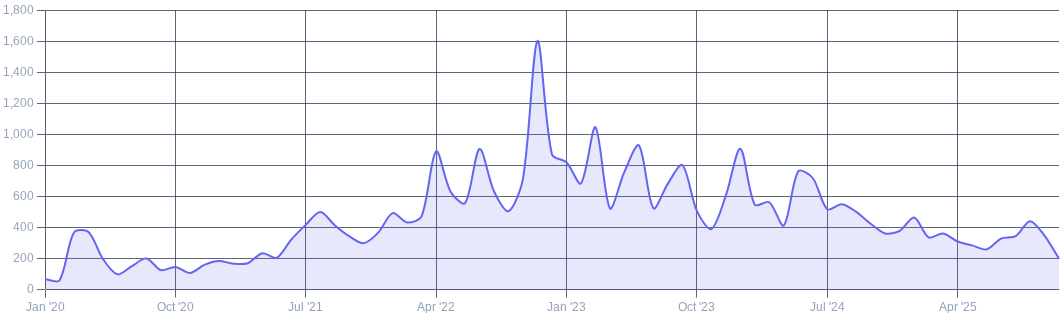
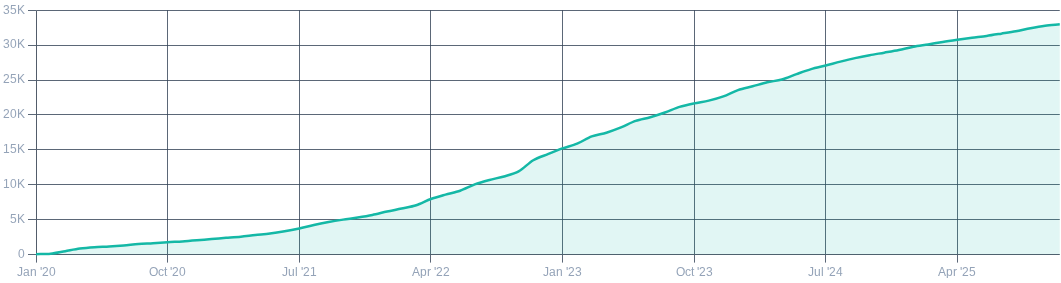
The majority of people posting about Long COVID did so before 2023, although the cumulative number of people who’ve ever posted about Long COVID continues to rise
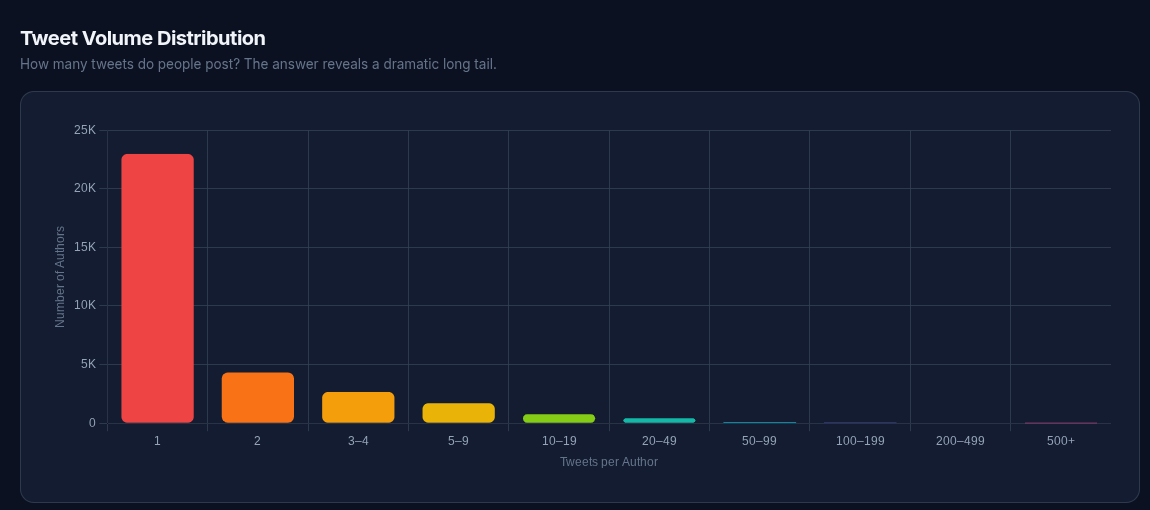
If we look at the frequency of posts dating back to 2020, there is a fairly broad distribution.
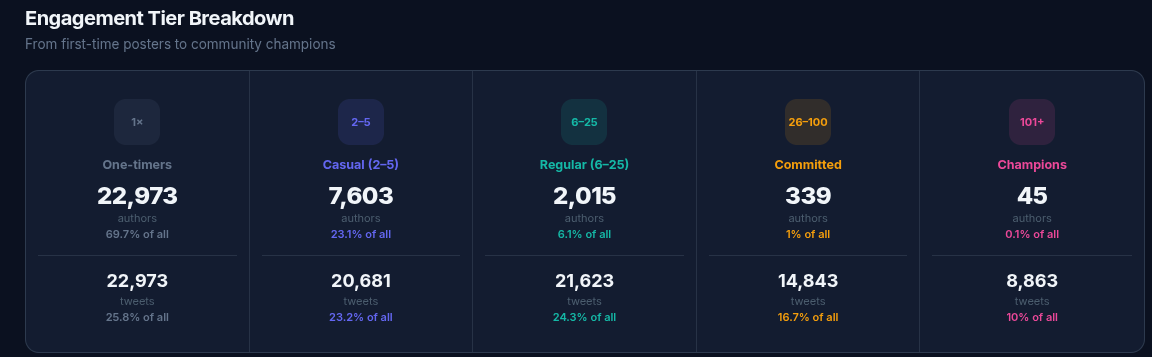
The majority of posters (69%) posted just once.
Meanwhile, 0.1% of authors (45 people) are the "Champions" posting 101+ tweets — yet they account for 10% of all content.
Over time we’ve seen a shift where the conversation has become more concentrated within a smaller number of authors posting more regularly.
When you look at the data we collected, you can see that the number of individual overall authors (purple) goes down over time, while the volume of tweets (pink) actually goes up each year.
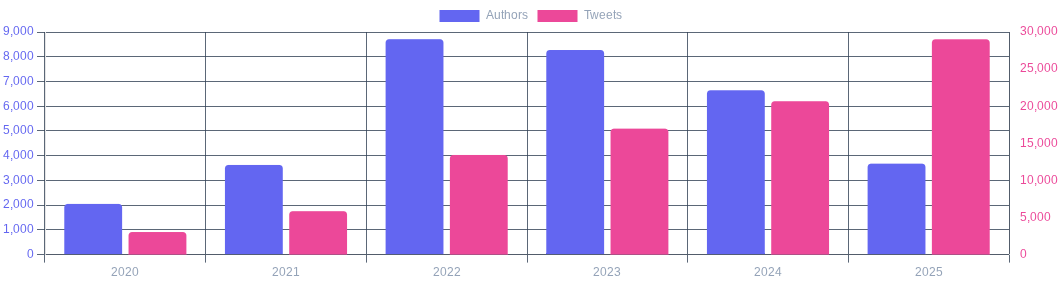
2025 had fewer new authors (3,677) than any year since 2021 — yet it had the highest tweet volume ever (29,018). The conversation is concentrating into a smaller, louder core.
We know the number of total Long COVID cases continues to rise, as new people unfortunately develop this condition every day. It is still a threat.
So why would there be fewer individuals posting about Long COVID now?
We can think of a few reasons:
2023 officially marked the end of the public health emergency worldwide. While we know these declarations had more to do with economic policy than scientific reality, the fact is that the public’s perception of SARS-CoV-2 as a risk has gone down. People are simply not paying attention to Long COVID the way they once were.
Additionally, lockdowns are over. Even people who may still be concerned with COVID-19 and Long COVID have, in many cases, needed to return to work and school in person, by necessity. They are simply not able to spend as much time online engaging with the Long COVID community, even though it may deeply matter to them.
Additionally, X ownership changed hands in late 2022 as Elon Musk bought the platform. Many users announced they were leaving the platform in objection to Musk’s vocal stances on many social and political issues.
According to the Wall Street Journal, by Sept. 2023 X had lost 16% of its user base. In contrast, other social platforms saw growth over the previous year, including Snapchat (+11%), Instagram (+8%), and TikTok (+3%).
Musk and X have since faced similar controversies, with additional users quitting the platform in protest of Musk’s political activities following the 2024 US Presidential election.
X is also now facing a lawsuit over its “Grok” feature allegedly allowing users to create pornographic images of individuals - including children.
Various polls show that X usage continues to drop. From 2024-2025, X usage among 18-29 year olds - the single biggest group of social media users fell from 42% to 33%
So it may be that the decline in #LongCOVID-related posts reflects a decline in people using the app overall, at least in part.
Our data shows that the Long COVID conversation has crystallized over time. As of 2025, we now see a smaller number of authors posting very frequently about Long COVID
These trends suggest that perhaps it is the authors who are the most motivated (and most able) to post frequently on a specific topic that are becoming authority figures in their online niche.
The X algorithm may also have a lot to do with this, in terms of whose content appears in users’ feed, and how it promotes certain authors based on their engagement.
Additionally, it may be that it’s truly the most motivated authors who are likely to sign onto the app and create content, whereas more casual users are more likely to simply browse.
While X is certainly flawed as a platform, we recognize its historical relevance in raising awareness of Long COVID,
At Long COVID Labs, we believe the conversation about Long COVID is important to have. Conversations between patients about what has and hasn’t worked have motivated many of the clinical trials going on today.
In addition, new people continue to develop Long COVID every day. Our online communities provide a safety net, sharing collective knowledge of what has worked so far.
As a way of expressing our gratitude to those who have led the Long COVID conversation, we have awarded Long COVID Labs points to the accounts our AI tool identified as sharing important LC information.
Depending on how many times you posted, each user has been awarded a certain number of points which can be redeemed for Long COVID Labs governance tokens.
These governance tokens allow you to take part in our system of collective governance.
We want to hear from Long COVID patients on which are the most promising treatments you think we should fund, and how you’d like to see the team focus our energy as we move forward.
For the Long COVID patients on X, you can download our Long COVID Moonshot app and connect your X account.
The app is available here for both iOS and Android.
We’ve pre-populated your account with points based on the number of tweets identified by our AI tool, and you’ll be able to see them on your account once you log into the app.

We’ll be sharing more info on how to redeem these for tokens moving forward!
In our next post, we’ll be sharing the data our AI tool collected about the most promising Long COVID treatments so far - and how information can be used to spur future research priorities.
Thank you all for being part of this important conversation, and creating a community for a disease which, in the beginning, did not even have a name.
Stay tuned for more data analysis coming up!
.png)
.png)