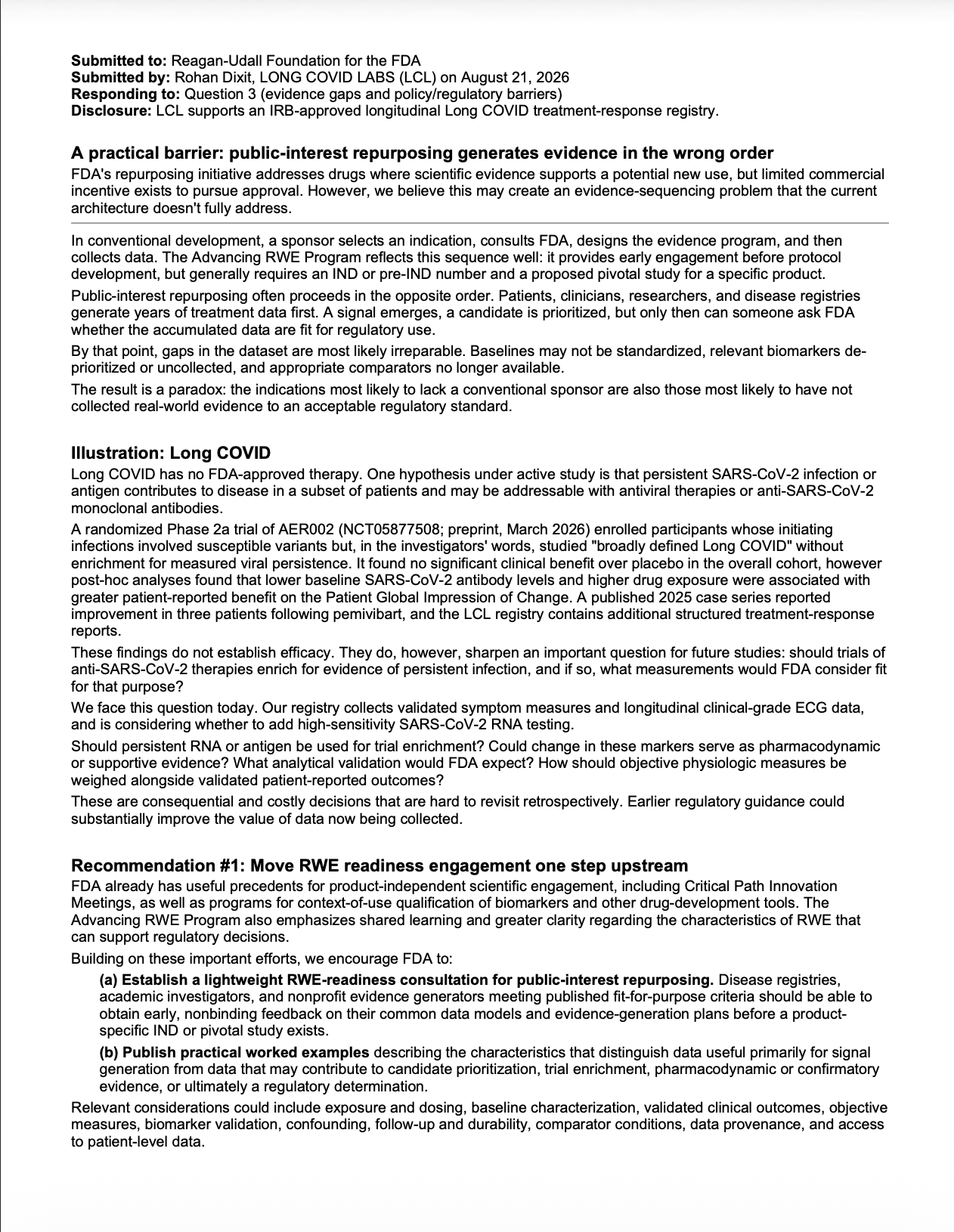
FDA advocacy on drug re-purposing
We submitted a letter to FDA advocating for greater patient access to re-purposed drugs, with specific recommendations.


For people living with Long COVID, the pace of research often feels painfully slow. Traditional clinical trials, while essential, are also rigid, expensive, and difficult for patients to access.
Patients who are home- and bed-bound may find traveling to a study site impossible - meaning that trials may not be able to recruit a study population that’s truly reflective of those living with this disease.
On top of that, many pharmaceutical companies have hesitated to invest, saying there isn’t yet a strong enough evidence base about Long COVID’s mechanisms. That leaves the small research community to shoulder the work of building the foundation—and progress has been incremental.
The FDA’s Real-World Evidence (RWE) rules provide a new pathway to approval at the FDA. Instead of relying solely on long and costly clinical trials, RWE uses data from medical records, patient registries, wearables, insurance claims, and even real-time patient reports. This makes it cheaper and faster to gather meaningful information about what treatments are helping (1).
Patients are already experimenting with therapies and sharing their results—sometimes on social media. These stories bring hope and can even hint at promising directions for research.
But anecdotes alone aren’t enough to convince regulators like the FDA or pharmaceutical companies to act. By systematically collecting this data in a scientifically rigorous way, we can begin to turn lived experiences into actionable evidence.
The FDA has begun to embrace RWE as a valid tool for expanding access to therapies. One example is Blincyto, a leukemia treatment. While it was initially approved through clinical trials, additional real-world data later helped expand its indications to include a broader patient population. The FDA largely based their decision on data from an open-label expanded access protocol of 41 patients, combined with real world data from patients who’d received the drug over the preceding years (2).
Another example is Carbaglu, a drug that treats high blood ammonia in newborns with a rare genetic disorder called NAGS deficiency. The condition is fatal if left untreated. The FDA approved the drug based on data from 23 NAGS deficiency patients who’d received the drug under emergency circumstances, after it was shown to reduce patients’ high blood ammonia levels and bring them into normal range within 3 days (2).
The World Evidence pathway allows the FDA to consider data from patients who receive a drug as part of their medical care - and may decide to make that drug more widely available.
At Long COVID Labs, we want to apply the same approach to Long COVID treatments. Our team is building a patient registry—an IRB-approved, standardized platform for patients who want to contribute their data. This registry will allow us to capture what’s already happening in the community:
By collecting and analyzing this information in formats that meet FDA standards, we aim to build an evidence base strong enough that regulators and pharmaceutical companies can’t ignore it.

Right now, most Long COVID patients access treatments off-label, which requires doctors to take on additional risk. This creates uneven access and leaves many patients without options. Our goal is to change that.
By generating irrefutable real-world evidence, Long COVID Labs hopes to accelerate the approval of effective therapies for new indications. The lived experience of patients is already pointing the way forward.
We’re creating a Patient Registry to transform the experiences of patients who are trying treatments right now (including those who are home- and bedbound) into real data that will change minds at the FDA and pharma companies.
Our team knows that Long COVID patients have been waiting far too long for answers. By harnessing real-world evidence, we can elevate the voices and experiences of patients into rigorous, actionable science.
We believe the Real World Evidence approach can bridge the gap between lived experience and regulatory acceptance—helping accelerate safe, effective therapies to the people who need them most.
1) Real World Evidence. US FDA, https://www.fda.gov/science-research/science-and-research-special-topics/real-world-evidence, accessed 7 Jan 2026.
2) Belson, N. (2018). FDA’s Historical Use of “Real World Evidence.” Food & Drug Law Institute, https://www.fdli.org/2018/08/update-fdas-historical-use-of-real-world-evidence/ accessed 7 Jan 2026.

.png)